Deep Dive 01 · From the Magic Gifts case
← Scaling Creative Stories Through Reusable Design KnowledgeFrom Ambiguous Creative Briefs to Structured Design Inputs
How personality, setting, action and interaction become connected story conditions, with room for AI to explore the details.
On this page: 01 / 06The missing story
The missing story
In Magic Gifts, creative designers had already produced strong work through individual exploration. My contribution was to organize that experience and improve the inputs used for further generation, working with the designers and technical colleagues.
Batch output could look polished while feeling uneventful: a character and a setting were present, but little connected them. The problem was how to carry the relationships behind a good story into the next generation.
Learn from strong examples
I collected strong examples and their prompts into a reference library, used AI to look for common patterns, and refined system prompts and templates.
The useful pattern was a relationship between choices: personality informs expression and behavior, the setting makes some outfits and activities more plausible, and interaction gives the scene an event.
- Character: what personality should remain recognizable?
- Setting: which clothing and activities belong in this situation?
- Interaction: what happens between characters, and what makes it interesting?
- Variation: which backgrounds and details can change while the story still makes sense?
Connect the story conditions
Consider a cool, tech-inspired cat at the seaside. Swim shorts and sunglasses connect the outfit to the setting; surfing gives the character an action. Pairing the serious cat with a playful dolphin adds a contrast the viewer can read.
These conditions give the LLM a story framework. Backgrounds, composition and smaller narrative details can still vary.
- Personality: a serious, tech-inspired cat
- Scene fit: seaside clothing and a surfing activity
- Interaction: a playful dolphin joins the serious cat
- Room to explore: backgrounds, composition and details
- Human review: does the whole scene feel coherent and worth choosing?
Explanatory example, reconstructed from my account of the method. It is not presented as a historical production asset or a before-and-after test.
Leave room for a new story
Too little structure can leave a polished image without a clear event. Too many constraints can reduce variation and liveliness. I adjusted the conditions by looking at generated results with the team.
- 01Connect the key choices. An outfit, action and expression should make sense together for this character in this setting.
- 02Reuse a useful relationship from a strong example while leaving room for a different scene.
- 03Keep variation where it adds possibilities, then check that it has not weakened the central story.
- 04Keep creative judgment with the designers and reviewers: a complete prompt does not establish a compelling idea.
Review what the input produced
The practical test was the generated batch: could the team find several coherent, interesting images worth choosing, with accepted images needing almost no changes before image-to-video?
This deep dive explains the input decision within the wider production case. It does not claim a separate measured improvement or a formal scoring method.
- Can a viewer tell what is happening?
- Do the personality, outfit, activity and setting belong together?
- Does the interaction add interest?
- Do the variations offer worthwhile choices rather than repeat the same idea?
An input interface experiment
The Lab Prompt Builder is an independent interface experiment. Local rules assemble example prompts, tags and criteria from selected options.
It demonstrates inspectable input assembly. It does not reproduce the story method above, the production process or the later workflow tool.
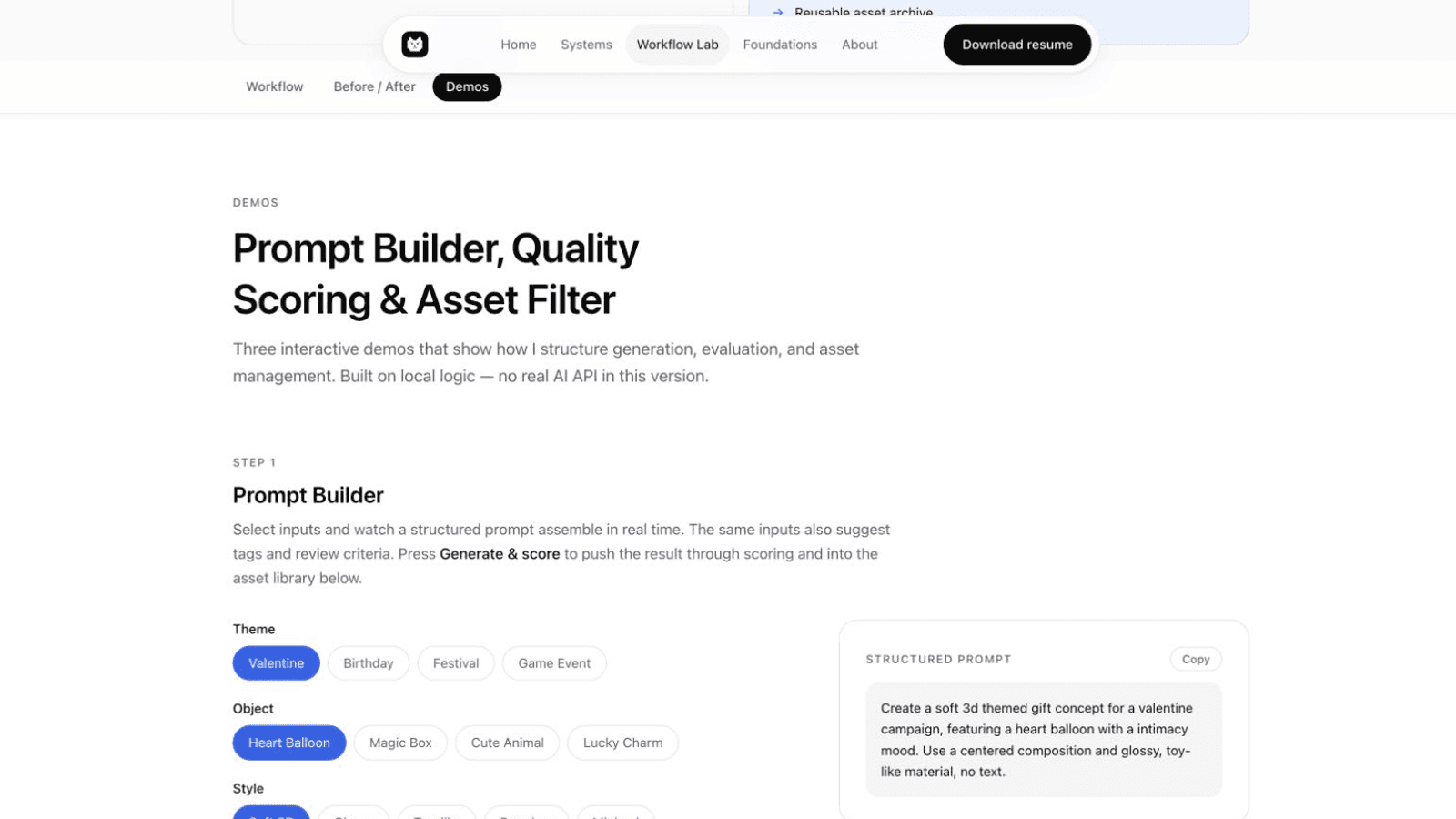
The interface is illustrative; its output is not evidence of production quality.
Explore a simplified demonstration using simulated logic and example data.